Friday, June 1, 2012

Gerard McNeil: I Carry Two With Me


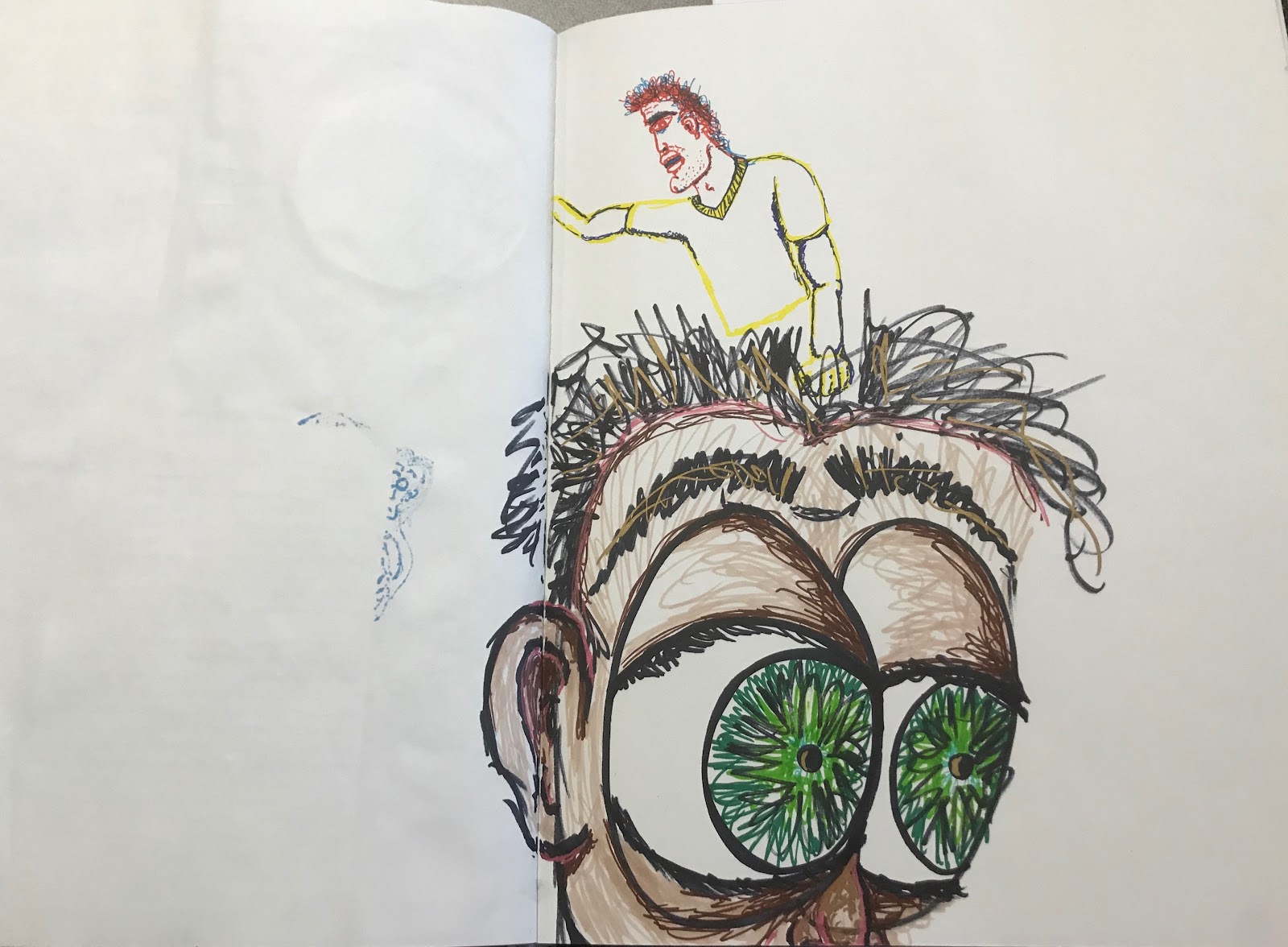
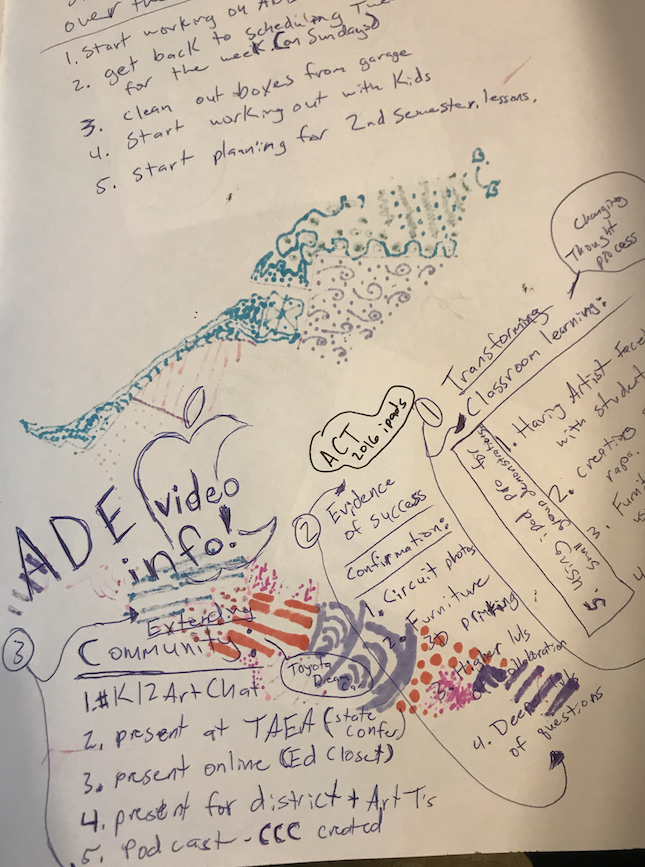
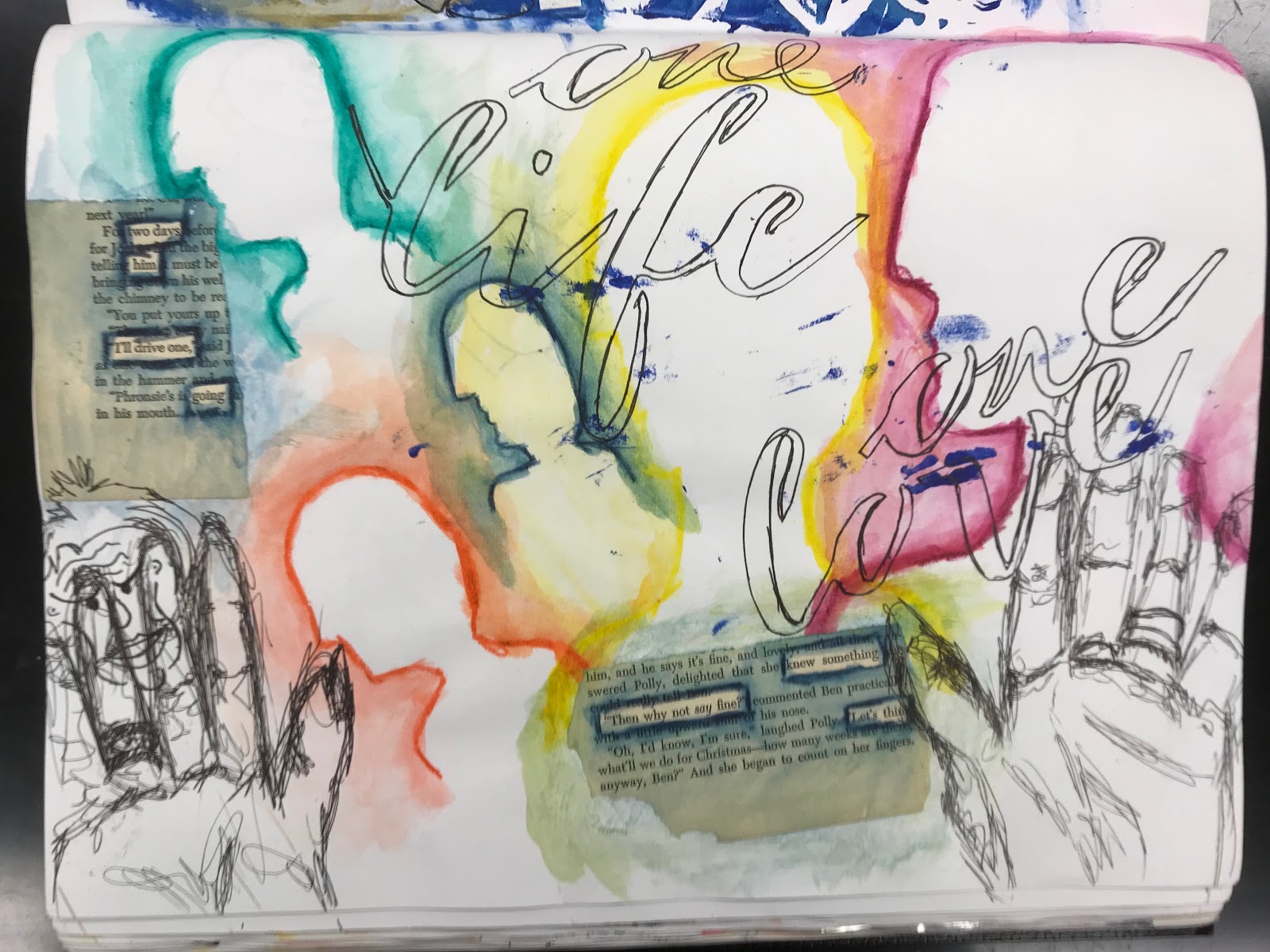
Instead of notebooks, I use what I call my idea books. I use these idea books for the planning of community based art education programs in my present role as Education and Outreach Curator with Veith Street Gallery Studio Association / Visual Connections Project. As you delve deeper into these idea books, you will find a number of educational programs or projects at various planning stages, requiring me to jump back and forth between these programs and projects. When I do share these idea books with others, people tell me that they feel like they are almost moving back and forth in time.


Very seldom will you find any sketches or drawings in my idea books, but there are a few. Numbering in the fifties, I have been using these idea books for the past twenty years; before this I used lined and unlined note pads. I still have a number of these old note pads that I have used for photo and art projects that go back more than twenty years. I have a separate studio journal and sketchbook for these projects.

I never leave the house or office without my idea books. In fact, I carry two with me, the one I am presently using and the last idea book I was working with because there is always overlap of ideas and projects from one idea book to the next.

In some ways I engage a project or program in my idea books in the same way I engage a visual arts / photo project. In my art practice, I remain open to the found or discovered photographic images. These images then lead me in new directions as I incorporate drawing and printmaking with the photographs. As an educator, I am intrigued by and open to other art and adult educators' practices and methods. Because of this, I sometimes find new ideas and methods that I may or may not incorporate into my own practice. Just like the constructed photo / drawing images, some of the incorporated methods or learning ideas from other educators become very successful, while others are not so successful.

I also use these idea books to reflect on programs that I have facilitated. This process allows me to see what worked and what did not. I will use these reflections in the revisions of past programs or in the development of new programs. Interestingly enough I was very resistant to this reflective process as an education student in university, but now see it as an essential part of my practice.

After attending an institute, I found myself in conflict with the facilitator of the learning program that focused on the creative process. After the program, I sat down and tried to articulate what creativity is. As you can see, I did not complete this as I still trying to figure this out.


A native of Halifax, Nova Scotia Gerard McNeil is the Education and Outreach Curator with Veith Street Gallery Studio Association. Gerard facilitates community based arts education, and professional development programs through the Visual Connections Project for persons with disabilities, community service providers and educators. Over the past twenty-seven years, Gerard has been engaged in a visual arts practice with exhibitions in Halifax, Toronto and St John’s. Along with his experiences in the visual arts, Gerard has been facilitating adult and community education programs more than fourteen years. Paralleling this experience is some twelve years in the Human Services field working with persons with disabilities.

Informing these experiences is an equally diverse educational background that includes, a Certificate in Photography from the Halifax Regional Vocational School (NSCC), a BFA in Fine Arts from the Nova Scotia College of Art and Design, a Certificate in Adult Education from Henson College (Dalhousie University), a B.Ed - Visual Arts Specialist degree from NSCAD and Mount Saint Vincent University. Gerard also possess an M.Ed in Adult Education from Mount Saint Vincent University, a Certificate in Non-Profit Sector Management from Henson College (Dalhousie University), and is a Certified PLAR (Prior Learning Assessment and Recognition) Practitioner.

You can visit Gerard's Idea books and studio journals at his blog, Mix and Shift.

Sunday, May 13, 2012

I'm the Addict of the Week!

Well, notebook lovers!  Sharing Our Notebooks was just featured at the blog, Notebook Stories.  If you have not yet visited this blog, let me just say that it is a notebook lover's paradise.  You might find yourself lost and happy there for hours, just reading all about notebooks and drooling over gorgeous materials and tutorials.

Thank you, Nifty!

Sunday, May 6, 2012

Kami Kinard: Notebooks For All Occasions


I’ve written a lot of blog posts recently to promote my book THE BOY PROJECT (Scholastic 2012) but I’m not sure I’ve ever been this excited about guest posting because I have a real thing for notebooks. I LOVE them. I RELY on them. I COLLECT them. I can’t help it. I like them so much that I’m even jealous of Amy for thinking of this absolutely unique, completely wonderful, blog!

I guess you could say I got my first notebook as a gift from my first grade teacher, who recognized my love for writing. I still have it. Take a look:


Later my notebooks were really diaries. I kept a lot of notes and drawings in them. Some of these diaries inspired me to write THE BOY PROJECT. Here is a picture of them.


I’m not a very organized person, so when I started writing full time, I found that notebooks were indispensable to me. Not loose-leaf notebooks though! I needed the spiral bound kind… the kind that wouldn’t allow me to lose pages. Books with sewn bindings work great too, especially for poetry. This shelf is full of my poetry notebooks. 


You can see a poem I was working on in the one below. This poem was later titled "Snow Sentinels" and was published in JACK AND JILL.


When I work on my fiction, I use a different kind of notebook. Now that I’ve discovered Picadilly notebooks, I rarely use anything else. Here is my shelf full of them:


These are spiral notebooks, but their covers are hard, so they are easy to write in when you travel, or when you need to relax in a soft chair. It is kind of like having a little desk attached to your notebook. Below is a page from a Picadilly notebook I was working in when writing THE BOY PROJECT.


Eventually, I filled so many notebooks that I had to get a notebook to organize my notebooks! You can imagine now, how thrilled I was when my book designers at Scholastic, Whitney Lyle and Kristina Iulo, decided to make the spine of my book look like a notebook!


Now a bit about my notebook collecting habit… It seems that I can’t stop collecting empty notebooks. Especially beautiful ones. I’m very particular about the pages though. The lines can’t be too heavy. They need to be light enough to keep the writing neat, but not so dark that they dominate the words. This is because as much as I love notebooks, I love words more! I collect those too, in books!

Every empty notebook is a potential story. Every empty page is a potential poem. This is the allure for me, and why when I see a notebook that looks like it’s just waiting for its pages to be filled… I buy it.

To celebrate the wonderfulness of notebooks, Kami is giving away this beautiful blank book. Please leave a comment on this post to enter, and the winner will be drawn on Sunday evening, May 13.


Kami Kinard’s first novel, THE BOY PROJECT: NOTES AND OBSERVATIONS OF KARA McALLISTER, debuted from Scholastic in January 2012. Her poetry, fiction, and nonfiction pieces have appeared in periodicals for both children and adults.  NASTY BUGS, a poetry anthology edited by Lee Bennett Hopkins, included her poem "Tick-Tock Tick." A teaching artist on the South Carolina Arts Commission’s Roster of Approved Artists, Kami holds a MAT degree with an emphasis in English. She grew up in Camden SC, and currently lives with her family in Beaufort S.C. 


Sunday, April 29, 2012

Heidi Mordhorst: A Penchant for Notebooks


When I was about eight, I realized that if I were going to the make the most of all the Saturday morning shows and cartoons that the new television season would bring, I would have to get organized.  I took the newspaper TV listings, a pad and pencil, and sat down to make the most efficient viewing schedule I could.  It took several drafts (each of them offering a new opportunity to dislike the look of my own handwriting), but I finally came up with a system for managing Saturday morning TV time.

At this same age I already had a penchant for notebooks, but because of the handwriting problem, I couldn’t bear to sully my lovely notebooks—hardbound blank books, not ordinary spiral or composition notebooks like I used at school—by actually writing in them.  In ninth grade my handwriting developed into something that looked as good as what was in my head, and sometime around 10th grade I began keeping a dated diary/journal/writer’s notebook—using some of those blanks books I had saved.

Both these stories tell something about my current notebook practices. “Time Existing and Available” continues to be my organizing principle in life, and trawling through the riches that other writers and artists have shared here I find that my way of using notebooks—which I thought was extremely common—is perhaps less common than I thought.

Instead of piles and stacks of various pads and pages and notebooks and napkins and walls and ticket stubs, I have a long series of notebooks which are essentially journals that proceed in linear chronological fashion from 1979 onward (and which include frequent attempts at scheduling and timetabling and controlling every aspect of life; I never learn).


Here’s my current dotty-spotty notebook, on top of a stack of notebooks dating from 2001. Since I started writing poetry in earnest in 1999, my pattern has been to draft once, twice, maybe three times in my notebook and then move the poem to a document for tweaking and formatting, for shaping.  I also keep a little “Bedside Poetry Journal” in case of late-night or early-morning strikes of inspiration.

My current notebook goes wherever I go, but since returning to full-time teaching this year, it has spent way too much time stuck in the depths of my bag.  Here’s why:


…my laptop. Because I use it for so many daily tasks, over the last couple of years it has increasingly and imperiously usurped the role of my notebook.  By November 2011, when I decided to try writing a poem a day, only the first two, disrespectfully crammed on a single page, appeared in the dotty-spotty notebook.  I wrote all the rest on the computer, in Word. 

It worked, but I really believe there is a different quality and a different pace to writing by hand, and of course it’s very hard to record the real process of revision if you’re editing a document rather than working over a page in your notebook with a pen.  So when Amy invited me to share my notebook, I vowed to return to drafting-by-hand, and it feels good!

Here are samples of notebook drafts that eventually graduated to computer documents for final tweaking and publication.  On the left, 7.23.02, you can see a Denise Levertov poem that really piqued my interested in “No-Poems,” poems which assert and then argue with themselves.  On the right and below are the first and then immediate second drafts of “What I Wanted and What I Got” from Squeeze (2005).  See how the form, the voice, the whole idea is wobbly the first time around, but under that squiggly line, it starts to firm up?


Next, from May 2006, you can see that I do occasionally find myself without a notebook.  These are the first and immediate second drafts of “Shell Game,” from Pumpkin Butterfly (2009).  I wrote these on a pad sitting in my car outside a school where I knew I would be doing several poetry visits, including one to a class that was incubating chicks.  It wasn’t until I got the draft typed up that I saw it would be possible to make it egg-shaped!  Once again, though, you can see me finding my way through the poem in the first draft, and coming almost to the final version in the second draft.


Finally, earlier this month I spent time at the Grand Canyon, writing a poem each day in the voice of an inanimate, nonliving thing.  Surrounded by rocks and sand, I wanted to highlight the counterintuitive way we call all those infinitely numerous particles by one uncontoured collective noun, and look what the messing around with singular and plural turned up! (And check out that note to myself in the upper right-hand corner…like I said, I never learn.)


We is and

millions and
billions and
trillions of us
all of us our own particular
grains and
crystals and
three-dimensional
shapes and
infinitely numerous
colors and
formed through unimaginable
eons and
from uncountable
eruptions and
erosions and
somehow we are all called
sand

Heidi Mordhorst 2012
all rights reserved


Being a classroom teacher, I have both a poetry challenge and a poetry prize suitable for classroom application! 

The Challenge

Students, I know that the first draft of any piece of writing is a lot of work, and when you’re done, it’s hard to imagine writing it all over again.  But an immediate second draft works well for me almost every time, so I encourage you to try it too.

1)  Write the first draft of your poem on the LEFT side of your notebook or paper.
2)  Read it out loud to yourself or a friend.
3)  Start writing it again on the RIGHT side of your notebook or paper.  Just start copying it with an
     open mind.
4)  As you write, let the poem show and tell you what might work better…a new arrangement?
     a better word here?  take out a word there?

Maybe you won’t find anything to change, but maybe you will.  By the end of the first draft, the poem is telling you what it wants to be; writing the second draft right away is your chance to show the poem that you’re listening!

The Prize

For a teacher who comments here, I have an unbound copy of PUMPKIN BUTTERFLY which I’ll take apart, laminate, and mail to you at school for use as a collection of two-sided poetry posters in your classroom.  Let me know if you want each poem signed as well.  The drawing will take place this Sunday evening, May 6, and the winner will be announced on Monday, May 7.

Thanks to Amy for inviting me to share my notebooks, and happy double-drafting-by-hand to all!

Heidi Mordhorst is a kindergarten teacher and poet who practices her arts in Montgomery County, MD just outside Washington, D.C.  Find out more about her books and other publications by visiting her blog at http://myjuicylittleuniverse.blogspot.com  or her website at www.heidimordhorst.com


THE WINNER OF ALLAN WOLF'S ZANE'S TRACE IS MICHELE KRUEGER!  
PLEASE SEND ME YOUR SNAIL MAIL ADDRESS TO AMY AT AMY LV DOT COM!

Thursday, April 26, 2012

Allan Wolf: I Wrote Obsessively on my Walls


When I was 13 I began my writing career by writing on my bedroom walls. I wrote nonsense phrases and drew bizarre pictures. I made up goofy rhymes and wrote down important events in my life. At the time, never really thought of it as a "notebook" or as a "journal" but my bedroom walls were both notebook and journal in one, a place where I could find my voice through writing and keep track of all the major events in my life.


I wrote obsessively on my walls all through Middle School and High School. I never asked permission, and my parents never forbade it. It was just something that I did. Years later, my mother would explain to me that she and my dad figured if I was going to be writing on walls, it was best that I did it at home.


I ended up writing a book, ZANE'S TRACE, about a kid, Zane Guesswind, who writes on his bedroom walls just as I did. Zane is convinced that whatever statements he writes on his walls will eventually come true. Although the book is obviously autobiographical, I was not as deluded as Zane. Yet I DO believe my walls had magical powers of a sort. The act of writing helped me to make it through a tumultuous youth. And although I no longer write on my walls at home (my wife won't let me) I still keep a notepad in my back pocket at all times. Just in case.

These are all "butt books" with pages filled front and back.  Notes about life. They go back years and years.  I keep 'em in a bin.  I break out in a sweat if I don't have one on me.  And a pen in my right pocket.  I've just gotten used to it. My wife and kids have gotten used to it.  It's just a thing we all take for granted.  "Oh there's Dad and his butt book."


And he descended from the mountain top, 
holding in his hand a little spiral note pad. 
And he called it "Butt Book."  
And it held a list of ordinary things.  
But when the poet wrote these ordinary things in the Butt Book, 
they became extraordinary.


But the Butt Book was lonely.  
And so the Poet brought forth a second Butt Book 
made in the image of the first except this one had more pages 
and was college-ruled and slightly more expensive.  
And together the Butt Books kept safe the many ideas 
which the poet wrote upon their pages.  
And the Poet decreed 
that the two Butt Books should love and cherish one another.  
(Although since they lived in North Carolina 
their union was not recognized by law.)


And in the years that followed
the Butt Books multiplied 
and begat many generations of Butt Books
and the Poet rejoiced and brought forth many inventive ideas 
which he wrote in the pages with his right hand, 
but sometimes with his left hand 
because the Poet was just like that. 


Allan Wolf is an author, poet, performer, and educator who lives in Asheville, North Carolina with his wife and three kids. After three years teaching at Virginia Tech, Wolf became the Educational Director for Poetry Alive!, a national touring company that presents theatrical poetry shows for all ages. Some of Wolf's books include THE BLOOD-HUNGRY SPLEEN AND OTHER POEMS ABOUT OUR PARTS (Candlewick), IMMERSED IN VERSE: AN INFORMATIVE, SLIGHTLY IRREVERENT, AND TOTALLY TREMENDOUS GUIDE TO LIVING THE POET'S LIFE (Lark Books), and THE WATCH THAT ENDS THE NIGHT (Candlewick). Conducting more than one hundred presentations every year, Allan Wolf is a veteran traveler through all the diverse worlds of verse from poetry slams to public schools, salons to saloons. And with literally hundreds of poems committed to memory, Wolf is always ready to spin out a stanza or two. Got rhyme?


Allan Wolf has generously offered to send a personalized copy of ZANE'S TRACE to a reader of this post. Please just leave a comment below to be entered in a drawing.  The winner of  ZANE'S TRACE will be selected on Monday evening, April 30 and announced on Tuesday Morning, May 1.

The winner of NEST, NOOK, & CRANNY by Suz Blackaby is Janet F.! Please drop a line with your snail mail address in my e-mail box - amy at amylv dot com. Congratulations!

Tuesday, April 24, 2012

Suz Blackaby: Please Pass the Napkins

So when it comes to notebooks, it turns out that I have a ridiculous number and variety in my greedy possession: linen-over-boards-in-pleasing-colors; high-end paper with/without lines/grids; handmade by dear friends; lovingly and cleverly chosen by traveling family members; discovered in quaint corners of art, paper, writing, museum, &/or book shops; etc.  I stockpile a stockpile.  Turns out this is maybe an illness....

hoard (n.): cache, stockpile, stock, collection, supply, reserve, reservoir, fund, accumulation, treasury, stash, gathering, set, assortment, pool

hoard (v.): save, store, amass, stockpile, accumulate, collect, gather, put aside, hide away, squirrel away, assemble, accrue


Once in a while, I choose one of my stash for a special occasion, such as a weekend conference or writing retreat.  Or I go buy a brand new notebook (using a very sophisticated and complicated algorithm to verify merit and rationalize need).  But in the humdrum of daily writing, I rarely use one of my beautiful notebooks for my messy brain dumping, the equivalent of party shoes in a sandbox.  No, no, no.  There are old envelopes for that.  Posties that float out of magazines.  College-ruled spiral-bound three-subject notebooks from universities I've never attended.  Napkins.

Here you can see some examples from my notebook hoard collection piled up on my writing-arm chair.


I recently participated in a March Madness poetry tournament sponsored by Think Kid, Think!  Participants were assigned a random, arbitrary, and sometimes impossible word to work into an 8-line poem.  My first-round word was "dilapidated."  I went to my trusty Thesaurus to excavate down through layers of meaning that would inspire something inspired within the limited time frame, as shown on this notebook page.


And here is the resulting poem, which went from barn to cattle to horse to cat as its broken-down subject and requited approximately 1/4 box of Cheez-its per stanza.

Dogged

Dilapidated cats --
Saggy backs, notched ears --
Steer through milky moon pools
To gather in back alleys.
Draped on dumpsters and crates,
They loll and caterwaul,
Waiting for scrapings and scraps
That come from fish (they wish).

Building a poem from a single word or a small cluster of words is not a bad beginning, actually, and it can be the perfect jumpstart for a writing group or a workshop.  I often start a warm-up with an alphabetical word list to see if any combinations or images start to stick to the brain pan.  I also like to work with word tickets, which are simply favorite words jotted onto black stubs.  If you are setting out to make a set, include jazzy adjectives, vivid verbs, and plenty of homonyms and homographs.


The only rule is NO RULES, unless you insist on making some up. Depending on your mood,  you can choose a number of tickets and see where they take you, choose a certain number (5 or so) and incorporate all of them into one poem, or combine word tickets with some other prompt (poetic form, ekphrastic, theme, and so on). Then just grab yourself a napkin and have at it!

Suz Blackaby has worked in educational publishing for over 30 years.  On the clock, she hones her skills writing fiction and nonfiction titles for the K-8 audience, focusing primarily on struggling and emergent readers.  On her own time, she writes poetry, picture books, and middle-grade fiction and nonfiction.  Her collection of poetry entitled NEST, NOOK, AND CRANNY (Charlesbridge, 2010 was included on the New York Public Library's 100 Titles for Reading and Sharing and received The 2011 Liona nd the Unicorn Award for Excellence in North American Poetry.  Suz lives in Portland, Oregon, with her family in a lab-mandatory neighborhood.


Suz has generously donated a copy of NEST, NOOK, and CRANNY to a reader of this post.  Please just leave a comment on this post before late night Thursday, April 26.  The winner will be announced on Friday!

Congratulations to the winners of the Rebecca Kai Dotlich books! Lori Faas won BELLA and BEAN, and Renee LaTulippe won LEMONADE SUN! Please just send me an e-mail with your name and snail mail address to my e-mail at amy at amylv dot com.

Thursday, April 19, 2012

Rebecca Kai Dotlich: Let the Pen or Marker Play


I keep lots of notebooks, journals, and diaries.  All kinds of them.  Seems I can't stick to just one until I've used all the pages.  Oh, no.  I must fill a few pages helter-skelter here and there.  One day in one, the next day in another.  I hardly ever seem to write in linear fashion. I naturally scribble and jot all askew, catty-cornered, twisted, upside-down, you name it.

I keep my notebooks at home, but when I'm traveling I'll take very slim, thin ones along.  My favorites seem to be black Moleskines, but I am beginning to love the harder, larger sketchbooks with no lines - for doodles.  I think of them as doodle-dumps and scribble-sparks.  I have always doodled as I'm thinking (my dad did, too), and even though these never become a poem or the meat of a picture book, they might switch the lights on.  More than anything?  It's terrible-fun to go back and look at these pages years later.  I do keep small diaries that are more personal, but often they don't have anything to do with the writing process.

When I was a teenager, I wrote in a small pink diary with a lock and key.  Who knows what  happened to it.  I do still have a blue one that I used in college.


A published poem is very rarely ever started in a notebook.  In fact, I would have said never.  But going through all of them randomly, I found two brainstorming pages; one did get cobbled together to become a poem.

Notes from an Elephant Poem that Never Came Together


Poem from SONG AND DANCE, selected by Lee Bennett Hopkins
Published by Simon & Schuster

But for the most part, my poems just come from an idea or a word, and I start each on the keyboard.  I used to use lots of yellow notepads, but I don't anymore.  Unless I'm doing research for a poem, and then I will.  But those don't usually stay as a complete pad.  I end up tearing off the pages and scattering them around to see all the notes as I write the poem.  These are some of those pages I used for a poem in CASTLES.


Typically, my writer's notebooks are filled with words I hear, see, read, think up, love. I often play with color words, sound words, words I like the look of; I mix them up, melt them together, try out different combinations.  Any one notebook might include lists (favorite TWILIGHT ZONE episodes), jots, maps (I love maps), childhood names, street names, possible character names, random thoughts, childhood memories, details, passages from favorite books, words I clip from magazines and tape in (I did this when I was young), doodles, webbing, comic strips.


I tape into my journals lots of things like comic strips, old postcards and photos, magazine pictures that just capture my curiosity, overheard conversations, etc.  The things I write in my notebooks are not terribly important and more than not, they are scattered, one image or word not relating to the next (at the time), but I don't think of that.  I just let the pen or marker play.


I love to take peeks into other author and artist notebooks; we all dream and doodle differently on the page, and I am amazed by that.

Rebecca Kai Dotlich is a poet and picture book author of such titles as WHAT IS SCIENCE? (a 2006 Subaru SB&F prize finalist), and LEMONADE SUN (an American Booksellers "Pick of the Lists").  Her picture book, BELLA & BEAN, received the Golden Kite Honor Award as well as a Bank Street's Best Book of the Year award,  Rebecca's work has been featured on READING RAINBOW, and it her poems have appeared in magazines such as LADYBUG, HIGHLIGHTS, and STORYWORKS, as well as numerous anthologies, textbooks, and collections. She is a frequent speaker and promoter of poetry at conferences and workshops around the United States.  Rebecca is a word-keeper-collector, a mother of two grown children, and a grandmother of four.  She lives with her husband in Indiana, and you can visit her website here.


Rebecca has generously offered a hardcover copy of her picture book, BELLA AND BEAN to a reader who comments on this post.


And Boyds Mills Press has offered a paperback copy of LEMONADE SUN!


Please leave a comment below to be entered to win one these books!  The drawing will take place next Monday evening, April 23.

Congratulations to Natalie for winning the giveaway from Laura Shovan's post.  Natalie - please send me your address to amy at amylv dot com so that we can get you your book!