Showing posts with label Writing Notebooks. Show all posts

Tuesday, February 26, 2019

Brett Vogelsinger: Variations


One of the advantages of keeping a writing teacher’s notebook is that I have the opportunity to practice an idea or follow a thread more than once over the course of a day.  If I ask my students to respond to a poem or write in the manner of a particular poet, I will do so several times by the day’s end.

In my class we respond to a poem in a variety of ways.  Sometimes, we write “after” a poet, borrowing a first line and writing a sort of spin-off poem.  Here are my variations on the poem “Hope” by Ali Liebegott, experimenting with various first lines borrowed from the original.


In the following poem draft, I challenged students to write a line that sounds like it is from the poem “Famous” by Naomi Shihab Nye, almost like a “deleted scene” you might find in the DVD extras for the poem.  I challenged myself to also incorporates a vocabulary word from our study of the book Night to demonstrate usage.


And in this third example, I wrote lines in celebration of small victories or gratitudes in my life that the ending of “won’t you celebrate with me?” by Lucille Clifton drew out in my heart.


In all three cases, I see my writing change and sometimes grow throughout a given day.  

From this I have learned that the first idea is frequently not my best idea.  It gives me the opportunity to share that process with students the following day.  And it reminds me to have students create more than one variation on an idea. For instance, in the Lucille Clifton model, could students think of three different “come celebrate with me” statements to make about their own lives?  Might these be arranged into a poem of their own? Or might we evaluate which one has the best rhythm or the broadest appeal to an audience outside of the Writer’s Notebook? Or might this simply invite greater gratitude and cheer into my classroom?

Variations invite possibility, and possibility grows writers.  

Try it:  
If you are a teacher, find a poem or passage that inspires you and invite a class to write something that sounds a bit like it but also brings in their own voices.  Then, repeat this with several of your classes, writing something different each period. If you are feeling especially brave, write under a document camera! If you are not a teacher, then try this same process in your notebook across the space of three to four days, coming back to same prompt from a different angle each time.  Your first approach is seldom your best approach.

Real Brett & Wonderful Student Portrait of Brett

Brett Vogelsinger is a ninth-grade English teacher at Holicong Middle School.  He is advisor of the school’s literary magazine, Sevenatenine, and runs an annual blog project, Go Poems,  promoting daily poetry reading in the classroom. You can find him on Twitter @theVogelman.

Please know that Sharing Our Notebooks welcomes all kinds of notebook keepers - of any age and interest - to open up their pages and share their process.  At the present time, I am accepting all notebook entries and am especially hoping to receive more entries from boys and men who keep any kind of notebooks.  If you are interested in writing in this space, please contact me, Amy, directly.

Please share a comment below if you wish.

Monday, June 5, 2017

Linda Rief: Keeping a Notebook Makes Me Pay Attention

Notebook Shelf

Don Murray used to carry around laminated cards about the size of a bookmark, that said, “Nulla Dies Sine Linea—Never a Day Without a Line.” He gave them to anyone and everyone who asked him about writing. It was his mantra—and the most important advice he gave to all of us, the reminder to put our thinking down every day, or it would slip away.

Every day Don wrote in his daybook. “The most valuable writing tool I have is my daybook… All the writing in the daybook is a form of talking to myself, a way of thinking on paper….The daybook stimulates my thinking, helps me make use of those small fragments of time that on many days is all the time I have to write. There is no sign of struggle. I’m not fighting writing. I’m playing with writing. …The daybook also keeps my writing muscles in condition; it lets me know what I’m concerned with making into writing; it increases my productivity….(it’s a place) where you can do all the bad writing and bad thinking that are essential for those moments of insight that produce good writing.”

Influenced by Don, I keep a Writer-Reader Notebook. I have more than 25 years worth now, and I can trace every piece of writing I have ever done either personally or professionally, to these notebooks. I admit that I don’t write in my notebook every day —and I realize so many things I wanted to remember are gone. Still, what I have, gives me a lot from which to work and with which to play.

Every note I have ever taken at a workshop or conference, every passage I have wanted to remember from books I am reading, and all the pictures, sketches, and random notes I just didn’t want to forget, reside in these notebooks. The notebooks hold the nuggets of ideas I have saved that help me remember my thinking. In most instances I have no idea where or when I will use some of this writing, some of these sketches, or some of these professional notes, but they are there waiting patiently for the right moment—the moment when I need them.

I have moved from lined spiral-bound notebooks to large bound notebooks with blank pages. These work best for me—inviting sketching and leaving me room to set up the page in any way I choose. 

My students are prominent in my notebooks. My grandchildren have crawled, toddled and walked their way in also.

As we were watching the Anne Frank movie in class, I was sitting behind my students, watching how reverent and shocked they were throughout this movie. 

Sketch of Students
(Click to Enlarge)

On my oldest grandson’s graduation from high school I found pictures of him picking apples at our house, wanting to remember those little hands that have now become those of a young man. 

Photos of Hunter
(Click to Enlarge)

I have been teaching myself drawing—practicing what I read in journaling and sketching books. What have I learned, just like writing—practice, practice, practice--the more I sketch, the better it becomes. Sometimes the sketches lead to writing. Other times they simply allow me to slow down, take a breath.

I sketched Rye Ledges on a marine biology field trip with our students after several years of trying to get rocks looking like rocks. 

Postcard of Rocks
(Click to Enlarge)

Sketch of Rye Ledges
(Click to Enlarge)

As I was working at my computer one day I watched a squirrel at our bird feeder, grabbed my notebook, sketched and wrote. 

Bird Feeder

I ask students to sketch their thinking as readers and do it myself when the book creates images in my head. As I was reading The Great Gatsby I wrote out my frustration. 

Joy Sketch
(Click to Enlarge)

Reading A Separate Peace, there were so many passages I wanted to capture that I thought they had to be written on that tree I kept imagining. 

Tree
(Click to Enlarge)

And as we were reading and discussing “Nothing Gold Can Stay” from The Outsiders I kept thinking about how quickly the years go by and put together my thinking with images and writing from being a grandchild to watching my grandchildren. 

Circle of Life
(Click to Enlarge)

Painting & Reflection
(Click to Enlarge)

When I go to conferences and workshops I take notes in this notebook. Sketch notes from a workshop with Kylene Beers and Bob Probst last December in Maine. 


Workshop Sketch Notes
(Click to Enlarge)

Penny Kittle and I gave a presentation at the New England Reading Association. She asked us to draw our hands after showing Sarah Kay on YouTube saying her poem “Hands.” This has stimulated lots of stories for me, some of which have become longer pieces. 

Sketch Notes, Hand
(Click to Enlarge)

And what are the last two pages in my current notebook? An article cut from the newspaper pasted into my notebook with notes from Anthony Doerr after hearing him speak at the Portsmouth Music Hall, written in April. The cover of the latest book from one of my former students, Abby Carroll, and notes from her reading. Then nothing—until two emails from today that I did not want to forget. Jotted down—and dated. So much to remember.

Anthony Doerr Notes
(Click to Enlarge)

Book Cover, Notes, E-Mails
(Click to Enlarge)

One of the greatest pleasures of keeping a Writing-Reading Notebook, and asking students to keep one also, comes from hearing from one of them every now and then. Four years after having Lil in 8th grade, and having heard nothing from her for four years, I received this email:

Wednesday, January 17   9:51 PM

“Mrs. Rief,  I counted my journals tonight. I have written 21 since eighth grade. Thank you!”  Sincerely, Lil”

Keeping a notebook makes me pay attention to the world. It slows me down. It lets me breathe. It makes me a deeper listener, a stronger observer. It lets me think. It captures what I want to remember. It gives me a place to think, and think again.

Here's something to try.  Watch “Hands” by Sarah Kay on YouTube. Then, read the text of "Hands." Ask the students (I would suggest 8th grade and higher) to find a line they like and write off that line for several minutes. At another time they could trace their hand, as I have done and put some dash facts on each finger that remind them of a story that has to do with hands, as I did. They can go back to any of these pieces and extend the quick write to a more developed piece. This summer, carry your notebook with you. Sit in front of a painting at a museum and sketch it. Take it to the beach, sit by the lake or ocean and sketch what you see, write what you are thinking.


Linda Rief is the author or coeditor of five Heinemann titles, including Inside the Writer's-Reader's Notebook, The Writer's-Reader's Notebook, Adolescent Literacy, Vision and Voice, and Seeking Diversity , as well as the author of 100 Quickwrites. She is an eighth-grade teacher at Oyster River Middle School in Durham, New Hampshire, and an instructor in the University of New Hampshire's Summer Literacy Institute. She is also a national and international consultant on issues of adolescent literacy. In 2000 she was the recipient of NCTE's Edwin A. Hoey Award for Outstanding Middle School Educator in the English/Language Arts. Her classroom was featured in the series Making Meaning in Literature produced by Maryland Public Television for Annenberg/CPB. 

Linda and Heinemann are generously offering 2 giveaway books, so we will have two winning commenters on this post. Please leave your comment by Thursday, July 29, 2017 to be entered into a drawing for one of two of Linda's books: Inside the Reader's Writer's Notebooks or Read, Write, Teach.  I will announce the winners in this space on Friday, July 30, 2017 as well as on Twitter and at The Poem Farm Facebook page.

Inside the Writer's-Reader's Notebook pack

Read Write Teach

Please know that Sharing Our Notebooks welcomes all kinds of notebook keepers - of any age and interest - to open up their pages and share their process.  At the present time, I am accepting all notebook entries and am especially hoping to receive some entries from boys and men who keep any kind of notebooks.  If you are interested in writing in this space, please contact me, Amy, directly.  I took a little break from this blog to write Poems Are Teachers: How Studying Poetry Strengthens Writing in All Genres (Heinemann, Fall 2017)...but I'm back and welcome you!

Please share a comment below if you wish.

Monday, March 14, 2016

Stacey Dallas Johnston: A Fresh Perspective

Notebooks, like people, come in all shapes and sizes. Much like people, notebooks exist all around us ambiguously, yet many people never take the time to look below the surface. Students have been directed to “get a notebook” usually from the start of 1st grade until they graduate from high school. A notebook becomes an obligatory thing. A school supply. A requirement. However, if I, as a teacher, strive to give my students more to take away from my class than a supply list and obligations, I need to give them the opportunities and the tools to see things from a new perspective.

As a high school English teacher I strive for my students to see notebooks, literature, people, even themselves with a fresh perspective by looking below the surface as we journey through our year together.


I will preface this discussion about notebooks and learning and people by saying I am not the same teacher now that I was when I started 15 years ago. As a new teacher I had pedagogical skills and writing skills, but I lacked philosophy. 

Many new teachers or even pre-service teachers are asked to outline their “philosophy of teaching.” I remember writing my “philosophy of education” paper in graduate school, but for one billion dollars I couldn’t tell you what I wrote. Today, however, I can tell you what my philosophy is. My teaching philosophy is all about relevance, empathy, purpose, and growth. 

I need my students to learn with intent and to learn to use reflection about their learning to better understand not only my lessons but themselves. My students' notebooks have evolved into tools; they are not just school supplies.


I have always been a notebooker. I have also always been a writer. It is easy for me to understand the organic need to grasp a pen and write or doodle or brainstorm. For me, this is a natural process.


For some of my students, however, it doesn’t come as naturally. So, what’s a teacher to do when trying to introduce students to the world of notebooking? That’s a very good question. It is a question I am still trying to to fully answer, but for now I have a few ideas to share:


Use notebooks for reflection, not for high stakes assignments.
  • The notebook is more welcoming when the writers focus more on what they are writing instead of how many points it is worth. 
  • I have begun calling my notebooks “Meta Journals”. These tools for meta-cognition allow my students to think and reflect without the burden of strict due dates and grades.

Don’t dictate the product.
  • I have started to allow my students the opportunity to use the medium they see fit when responding in their notebooks, the caveat being that their notebooks must contain variety. 
  • Some students mind map, some doodle, some list, some write poetry, some launch into the great American novel. Regardless of the product, all students are going through the process of reflection, the most important part.

Set expectations, but allow for some autonomy and flexibility.
  • I have plenty of assignments queued up for each semester, the notebook doesn’t need to be in that category. We do a class inventory of the responses each quarter, and at the end of the semester, students look back on their responses as a way to reflect on their learning. I award points for participation but not for content. The notebook is a tool, and students needs to learn for themselves the power of meta-cognition and self-reflection.

This year, my students’ “Meta Journals” have allowed them to own their thinking and learning. The process of notebooking after we read, after we have class discussions, even after we take a test, allows them to take that next step beyond finishing a task or producing a product and reflect on the why of the process. I have enjoyed reading their responses. Once they got over the hurdle of being so concerned with directions and grades, they let go and started using their notebooks as tools.  The outcome has been great to observe.

Eve - Creative Writing Student: 
“I tend to work in layers. I write, then edit, then edit again, 
all on the same page in order to show my thoughts.”


Shelby-AP Literature & Composition/ Creative Writing Student: 
“To someone else, my notebook would look like 
a scribbled mess of smushed words and heavy sketches. 
To me, my notebook allows me to portray my thoughts in my own style. 
It holds everything from one-liners, random drawings and single words 
to finished piece, rejected lines and the sketches that inspired my work.”


Leslie - AP Literature & Composition Student: 
“Writing in my Meta-cognitive journal allows me to
 organize my thoughts, develop an opinion, and effectively analyze 
not only what we’ve read in class, but how I feel about it.”


Paige - AP Literature & Composition Student: 
“I use my notebook to collect my thoughts 
on what we’re focusing on in class 
and to make sure I keep all my ideas in one place.”

Try This!  Draw even if you can’t draw, write a poem even if you’re not a poet, write from the third person point of view. Do anything in your notebook that you wouldn’t normally do. This will allow you to use a new process and push you creatively. 

As a writer, I have found that drawing, even though I am terrible, always ends with me writing a piece I am happy with. For students, this breaks the rigidity of the standard paragraphing that they so often have to use when responding to class assignments.


Stacey Dallas Johnston is a full-time teacher, full-time mother, and part-time writer currently residing in Las Vegas, NV. Fifteen years teaching means over 2,500 students have passed through her classroom door. Together with her students and peers she reads, writes, and discusses literature, composition and creative writing while continuing to develop her own craft. As a fellow of the Southern Nevada Writing Project, she has worked at the state and national level to enhance the teaching of writing in public education. 


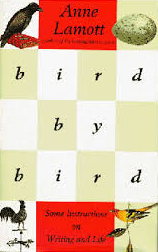
Sharing Our Notebooks will give away one copy of one of Stacey's favorite books about writing, Anne Lamott's BIRD BY BIRD: SOME INSTRUCTIONS ON WRITING AND LIFE.  Please leave a comment, including a way of contacting you should you win, by Sunday, April 3, to be entered into the drawing.

Please know that Sharing Our Notebooks welcomes all kinds of notebook keepers - of any age and interest - to open up their pages and share their process.  At the present time, I am accepting all notebook entries and am especially hoping to receive some entries from boys and men who keep any kind of notebooks.  If you are interested in writing in this space, please contact me, Amy, directly.

Please share a comment below if you wish.